AI-Assisted Journaling for Reflection

Why Mindful
Expressive writing can help people process everyday emotions, but an empty journal does not automatically lead to reflection. Writers may stop at recounting events, struggle to name what they feel, or return to the same interpretation.
Generative AI makes this support responsive to each entry by tailoring reframing questions and visual cues to the writer’s evolving narrative.
I designed Mindful to add gentle structure around the writer’s own words. The system uses AI-generated reflective questions and imagery, along with mood trends, to help people reflect on and revisit their experiences from different perspectives.
The design problem
How might a journaling tool help people move from recording what happened to making meaning from it?
The design response
Keep writing open-ended, then offer optional visual and question-based prompts that make reflection easier to continue.
Design Principles
Start with the writer, not the model
People first describe their day in their own words. AI support comes afterward, so the journal remains an act of self-expression rather than AI-authored writing.
Ask instead of answering
Mindful generates open-ended questions rather than advice or diagnoses. The questions invite people to elaborate, reconsider an experience, or notice a meaning they had not explored.
Make emotion easier to see
AI-generated images offer another representation of the entry’s emotional tone. Six visual styles let writers choose a language that feels closer to how the experience felt.
Support reflection over time
A simple mood check, journal history, and visual timeline help writers reconnect daily emotions with the experiences that shaped them.
Design
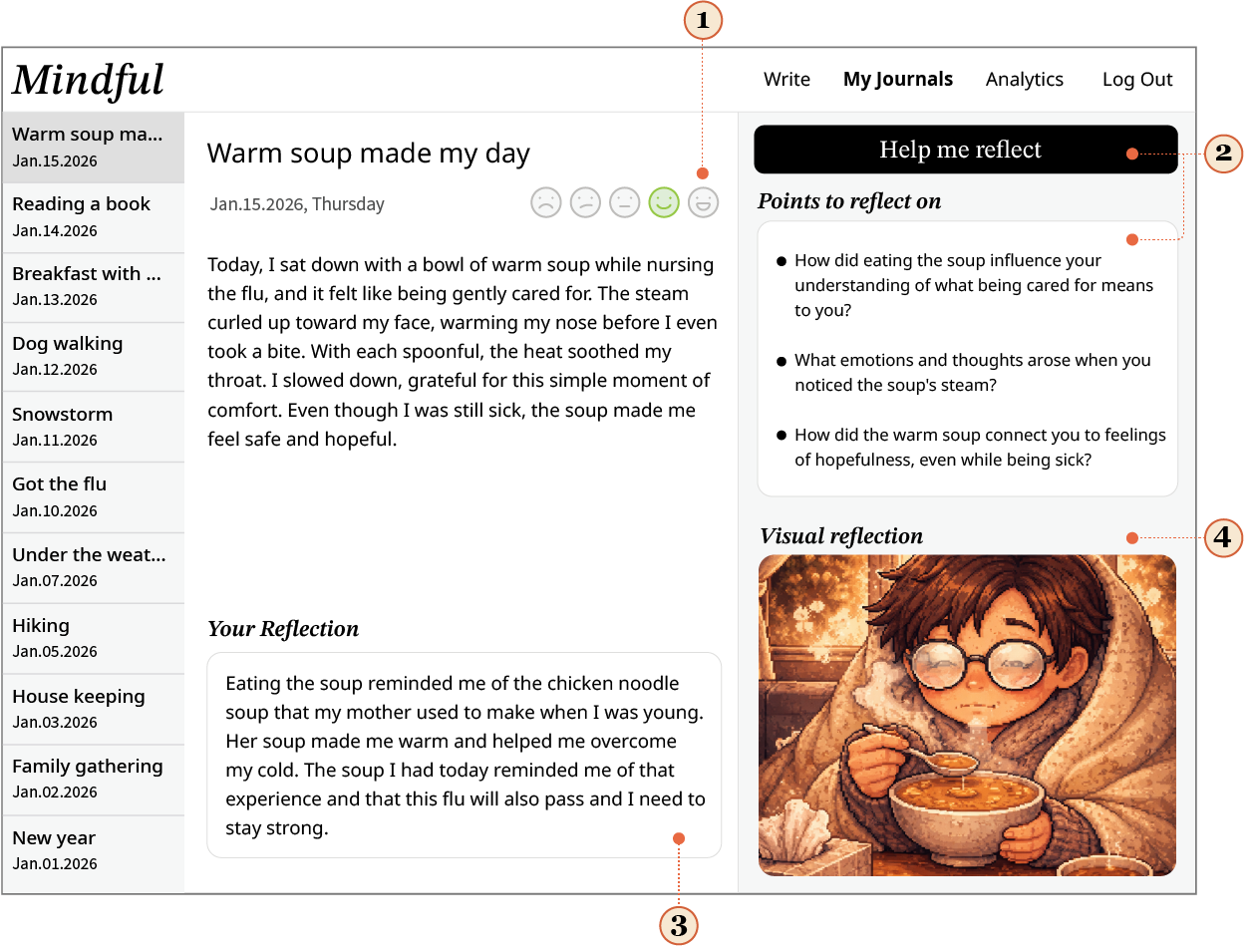
Write and check in
Writers record their day freely and rate their mood with a lightweight emoji scale.
Receive reflective questions
Questions grounded in the entry encourage deeper consideration without prescribing an answer.
Continue in your own words
Writers choose what feels useful and add a reflection; the response is not fed back into an endless AI conversation.
See another perspective
A generated image externalizes the day’s emotional qualities and becomes a visual anchor for later review.
Designing for Responsible AI
Personal journals can contain vulnerable experiences. A generated image or question that is inappropriate, misleading, stereotyped, or emotionally triggering can do more harm than a generic AI error.
Review before delivery
Generated questions and images stay hidden until a trained reviewer checks them for safety and emotional appropriateness. Rejected content is never shown to the writer.
Balance safety with timing
The study revealed a real tradeoff: human review protected participants, but delayed feedback could arrive after the reflective moment had passed. A future version would automate routine checks and reserve human review for flagged outputs.
Study
We ran a seven-day field study with 30 adults to separate the effect of AI-generated visuals from the effect of reflective questions. Ten participants were randomly assigned to each condition.
Writing only
Daily expressive writing and mood check-ins without generated content.
Writing + AI visuals
Daily writing followed by an AI-generated visual reflection.
Writing + visuals + questions
Daily writing supported by both a generated image and reflective questions.
Participants completed a short survey after each session. Ten also joined 30–45 minute interviews about emotional expression, reflection, privacy, and how the AI support changed their experience.
Results
The study did not show a simple “more AI is better” effect. The value of AI depended on whether it felt relevant, arrived at the right moment, and left the writer in control.
Writing remained the foundation
Across conditions, participants credited the act of writing—not the generated content—with helping them process emotions and understand their own thinking.
“Writing was just a tool that helped me better understand the train of thought for emotions.”
P31 · Condition 1 · Writing only
Images worked when they matched the feeling
Emotionally resonant images made feelings more visible. Literal, generic, or identity-mismatched images broke trust and could distract from reflection.
“Sometimes the image just made me realize my emotions I hadn’t fully noticed when I’m writing.”
P4 · Condition 2 · AI visuals
Questions offered a useful second perspective
Reflective questions helped participants move beyond recounting events. Their tone still mattered: questions that sounded evaluative could feel like judgment.
“When it came to the reflection question, I was like, ‘Oh, I didn’t think about that.’”
P17 · Condition 3 · AI visuals + reflection prompts
Perceived value mattered more than feature count
When people experienced the AI content as creative, expressive, and useful, they also reported deeper reflection and stronger engagement.
“It was an interesting experience, because it not only forced me to journal consistently over a week but also there was an AI generated component to it, which increased my curiosity and anticipation when journaling.”
P22 · Condition 2 · AI visuals
Design Implications
Make AI optional for every entry
Participants diverged: some opened up to AI feedback, while others self-censored or preferred plain writing. Per-entry controls and a no-AI mode preserve choice and privacy.
Generate emotional atmosphere, not a literal event log
Images helped when tone, color, and atmosphere carried the emotion. Literal or identity-mismatched scenes broke trust and distracted from reflection.
Let writers select the passage, adjust the style, and regenerate
AI often overemphasized incidental details. Letting writers choose the passage, tune the style, and preview or regenerate the result would keep them in control.
Offer support at a chosen moment with safe, non-judgmental wording
Delayed feedback missed the reflective moment, while evaluative questions could feel judgmental. Let writers choose the timing and use curious, skippable prompts reviewed for safety.